Webinar Recording
By the Numbers: June 2026 Data Summary
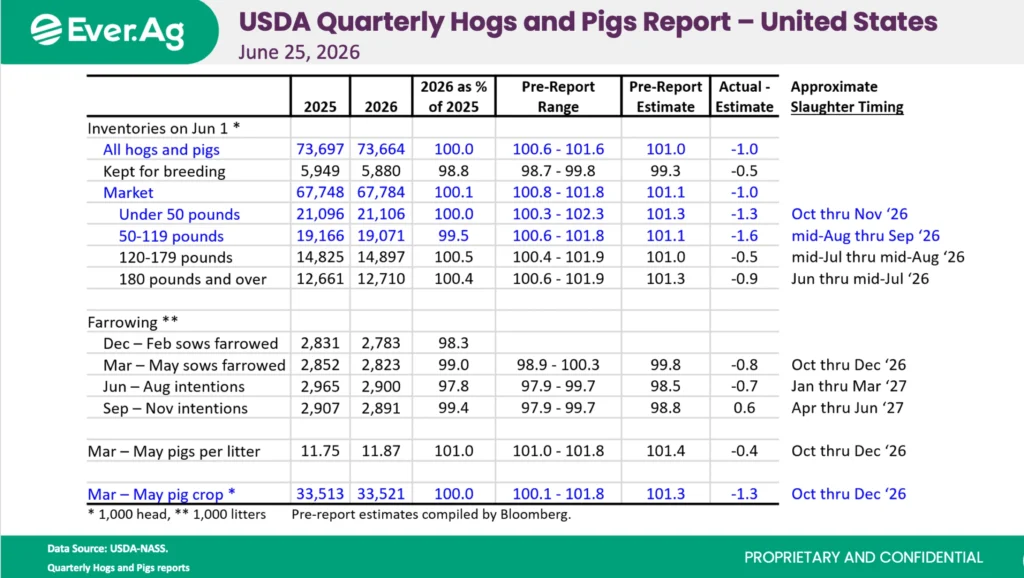
Hosted by Iowa Pork Producer and National Pork Board (NPB) Member Kevin Rasmussen, the NPB webinar features an in-depth analysis by Lee Schulz, chief economist at Ever.Ag. Reviewing the June 1, 2026, data, Schulz noted that the total U.S. inventory of all hogs and pigs sat at 73.664 million head, remaining flat compared to the June 1, 2025, level.
One of the most notable shifts, however, was in the kept for breeding category. The breeding herd contracted to 5.88 million head, a 1.2% decrease from a year ago. According to Schulz, this marks the smallest June 1 U.S. breeding herd since 2014. Meanwhile, the total market hog inventory saw a modest bump, up slightly from June 1, 2025, to reach 67.784 million head.
Market Hog Inventories Signal Tighter Than Expected Summer Supplies
When examining the market hog inventory by weight category, Schulz noted several surprises that provide clues about upcoming slaughter volumes. The inventory of hogs weighing 180 pounds and over on June 1, 2026, was up 0.4% compared to June 1, 2025, which came in well under the average of pre-report expectations of up 1.3%. Hogs weighing 180 pounds and over on June 1 are expected to come to market in June through mid-July. The inventory of hogs weighing 120 to 179 pounds was up 0.5% compared to a year ago. These hogs would be expected to be harvested mid-July through mid-August. On average, analysts expected this inventory to be up 1.0%. This market hog inventory category was the closest the average of pre-report expectations came to the published USDA inventory.
Conversely, the two lightest weight market hog categories came in much smaller than analysts anticipated. Pigs weighing 50 to 119 pounds, slated for mid-August through September slaughter, were down 0.5% compared to June 1, 2025, falling 1.6 percentage points below the average pre-report expectations and even well below the lower bound range of trade estimates. Lastly, pigs under 50 pounds were even with year-ago levels, missing the 1.3% expected increase.
Record Productivity Offsets a Smaller Breeding Herd
Despite the shrinking breeding herd, the U.S. pig crop is holding steady and only about a million head off record highs due to continued gains in on-farm productivity. Sows farrowed during the March through May 2026 period fell by 1.0% year-over-year to 2.823 million litters. However, this decline was entirely offset by a 1.0% increase in pigs saved per litter for the quarter. This surge in productivity held the March through May 2026 pig crop steady at 33.521 million head.
Schulz highlighted that, remarkably, the pork industry has now achieved a five-year stretch featuring 20 consecutive quarters of record or record-tying productivity. Looking ahead, the smaller breeding herd may be a leading indicator of tighter supplies, as U.S. hog producers intend to have 2.90 million sows farrow during the June through August 2026 quarter, down 2.2% from the actual sows farrowing during the same period one year earlier. Intended sows farrowing for September through November 2026, at 2.891 million sows, are down 0.6% from the same period one year earlier.
Historical Context and State-Level Records
Putting the current supply into historical perspective, Schulz noted that the U.S. market hog inventory of 67.784 million head on June 1, 2026, is over three million head smaller than the COVID-inflated peak due packing plant disruptions seen on June 1, 2020. Nonetheless, the latest June 1 market hog inventory is still the fourth highest market hog inventory for the quarter in the last eight years.
While national inventories are relatively flat with year ago levels, some individual states experienced significant growth. Driven by 12.1% year over year increase, the Michigan all hogs and pigs inventory on June 1, 2026, of 1.3 million head tied a record high for the quarter and was only 100,000 head fewer than the record for any quarter in the state. Iowa also tied a record high for the June 1 all hogs and pigs inventory at 24.7 million head. This was only 700,000 head smaller than the record all hogs and pigs inventory in Iowa of 25.4 million head on September 1, 2025.
Ultimately, the report indicates that overall supplies remain close to a year ago, reflecting a slightly bullish market navigating tighter-than-expected inventories.


